
Disguised Alpha   /   Compound references. Original research.
AniracetamResearch reference

Racetam / AMPA receptor research

AniracetamExplore the evidence.

Aniracetam is a synthetic pyrrolidinone compound studied for its effects on glutamate signaling and cognition. Its research history spans receptor experiments, animal behavior, and older trials in people with cognitive impairment. These are different kinds of evidence: a measurable receptor effect does not establish improved memory in healthy people. The human trials highlighted here reached different conclusions, making study design and population central to interpretation.

Mixed human and preclinical evidence

A focused reference from the Disguised Alpha research network.

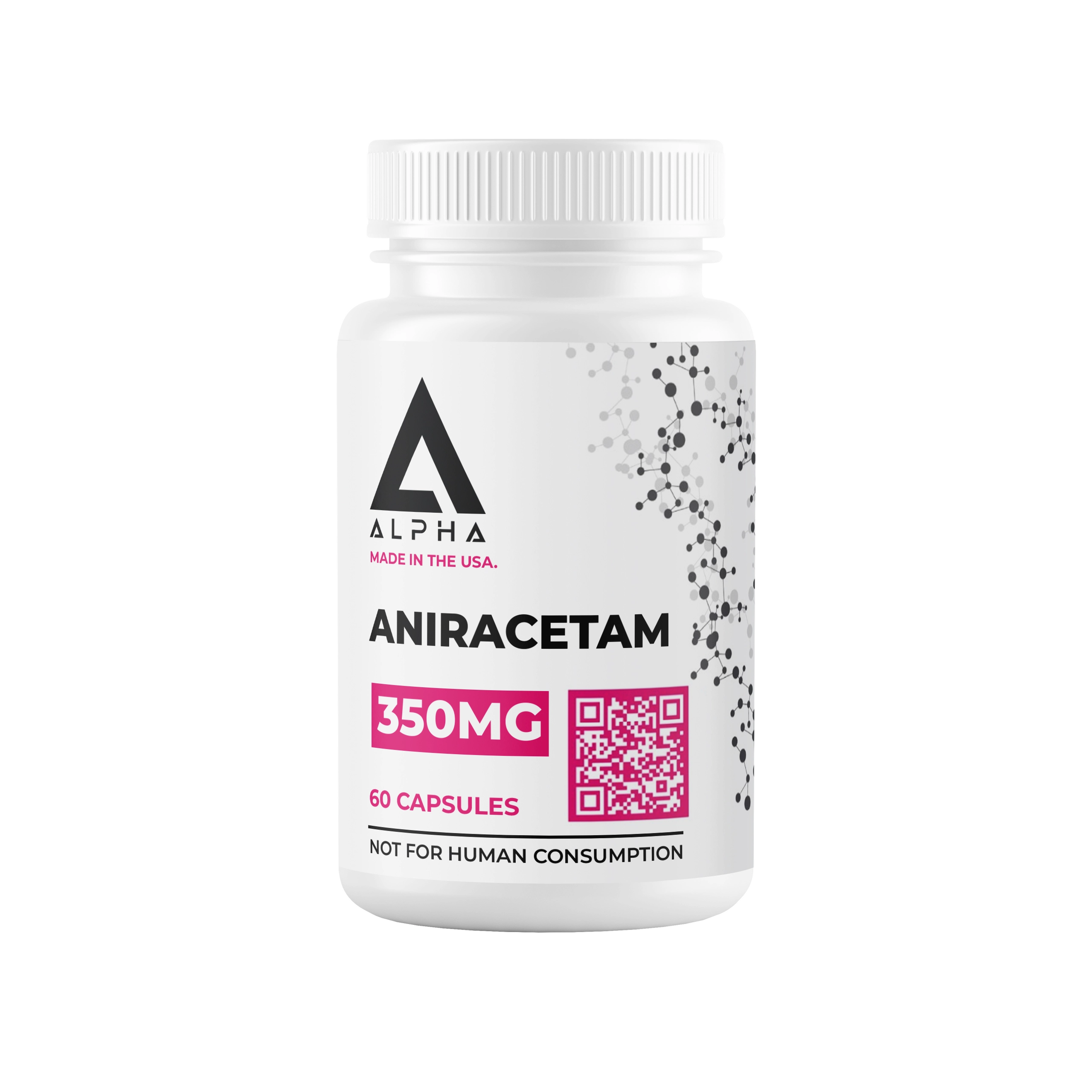
Disguised Alpha Aniracetam product reference image
AniracetamCatalog imagery · RUO
Molecular formula
C₁₂H₁₃NO₃
Molecular weight
219.24 g/mol
PubChem CID
2196

Disguised Alpha catalog

Find the matching product.

Open the exact product listing for its format and documentation. Published studies do not validate a supplier’s finished product.

01 / The science

Understand the research focus.

A clear starting point for the mechanisms, experimental models and questions behind the compound.

01

AMPA receptor signaling

Aniracetam potentiated AMPA-related responses in frog oocytes expressing rat brain receptors and in rat hippocampal slices. The work supports an allosteric mechanism: modifying a receptor response rather than simply replacing glutamate. Findings from isolated experimental systems cannot specify the size or reliability of an effect in a person.

Read the primary source ↗
02

Receptor structure and kinetics

Structural and electrophysiology experiments place aniracetam at the interface between AMPA receptor subunits. Researchers linked this interaction to slower receptor deactivation. This offers a molecular explanation for a laboratory observation; it does not answer whether a particular commercial formulation changes everyday cognition.

Read the primary source ↗
03

Clinical context matters

Older placebo-controlled trials enrolled people with Alzheimer-type dementia or probable Alzheimer disease. One reported no clinical advantage, while another reported differences favoring aniracetam. Their differing populations, durations, and outcomes should remain visible rather than being compressed into a claim that aniracetam reliably improves memory.

Read the primary source ↗

02 / Read with context

Know what the evidence can tell you.

The selected research applies to the tested molecule, experimental model and conditions. It does not establish equivalent effects for a commercial formulation or support assumptions about clinical benefit or long-term safety.

Start with three questions.
01What was tested?
Check the exact molecule, sequence, composition and formulation.
02Where was it tested?
Cells, animals and clinical populations answer different questions.
03What was measured?
A pathway signal is different from a demonstrated clinical outcome.

03 / Selected publications

Go straight to the source.

Original records, study models and the limits that matter when interpreting a result.

STUDY 01 · 2005
Receptor crystal structures and patch-clamp experiments

Mechanism of positive allosteric modulators acting on AMPA receptors

The investigators identified a binding site for aniracetam in the GluR2 ligand-binding domain. Mutations affecting that site disrupted modulation, supporting a relationship between the observed structure and receptor behavior.

Reading limit: This is mechanistic evidence from experimental receptor systems. It does not measure clinical benefit or long-term safety.

↗
STUDY 02 · 1987
Randomized, double-blind trial; 44 patients; three months

Senile dementia of the Alzheimer type treated with aniracetam: a new nootropic agent

Both groups improved on some cognitive tests, but the clinical assessment found no efficacy difference between aniracetam and placebo. Confusion led to discontinuation in four aniracetam recipients and one placebo recipient.

Reading limit: This small, older trial concerns dementia, not healthy-user enhancement. A separate 1991 trial of 109 patients reported a different result.

Aniracetam (Ro 13-5057) in the treatment of senile dementia of Alzheimer type (SDAT): results of a placebo controlled multicentre clinical study ↗
↗
STUDY 03 · 2014
Healthy adult mice; behavioral test battery

Aniracetam does not alter cognitive and affective behavior in adult C57BL/6J mice

Researchers found no significant group differences across tests of learning, memory, motor behavior, anxiety-related behavior, and repetitive behavior. The negative findings are relevant when claims extend from impaired models to healthy subjects.

Reading limit: A mouse result cannot settle human efficacy. It does show why benefits should not be assumed across models.

↗

A focused selection, not a systematic review. Studies concern the tested material and do not validate a supplier’s finished product.

Explore research & source notes →

04 / Common questions

A little more clarity.

Quick answers for reading the science behind Aniracetam.

Is aniracetam a peptide?

No. Its recorded structure is a small organic molecule containing a pyrrolidinone ring and a methoxybenzoyl group. Chemical identity and a product’s format are separate questions.

Does AMPA modulation prove a memory benefit?

No. Receptor modulation establishes activity in the tested preparation. A claim about memory requires appropriately controlled behavioral or clinical evidence in the population being discussed.

Were human studies performed?

Yes. The cited clinical trials studied cognitive impairment and dementia, with mixed results. They should not be presented as demonstrations of improved cognition in healthy adults.

What should readers check in a study?

Look at the enrolled population, comparator, duration, outcome measures, withdrawals, and tested formulation. A positive finding in one setting does not erase a negative study in another.

Continue your research

One compound. A wider research library.

Explore the complete Aniracetam profile and related compounds in the Disguised Peptides research hub.

Open the full profile ↗